How to Choose the Right Container BESS for Large-Scale Energy Storage?
Release time: 2026-09-08
Table of Contents
Large-scale energy storage projects need to balance storage capacity, power output, safety, installation conditions, and long-term operating costs. Choosing the right container BESS is not simply about selecting the largest battery. The system needs to match the actual energy demand and operating conditions of the project.
Founded in 2013 and based in Hefei, China, Enjoy Solar provides photovoltaic and energy storage products for international markets. Its product range includes lithium batteries, solar panels, photovoltaic inverters, and energy storage systems. For larger storage projects, its outdoor lithium battery container provides a flexible way to combine battery storage and supporting equipment in one container.
Product Overview
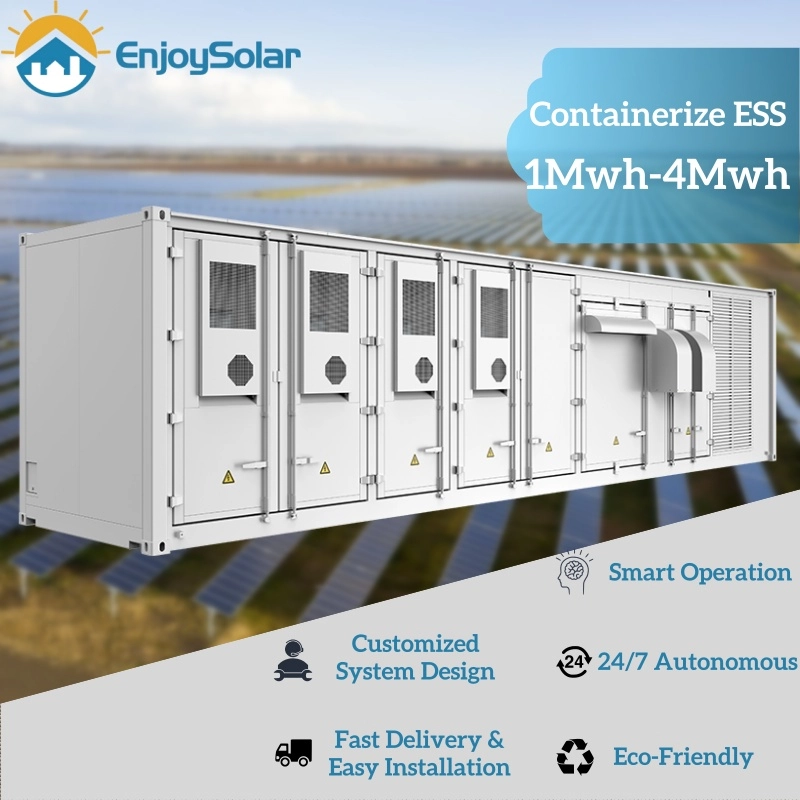
The 1MWh, 2MWh, and 5MWh BESS outdoor lithium battery container is designed for large-scale energy storage applications. The system is available in 20FT and 40FT container configurations, with different battery capacities and PCS power options. Battery racks, PCS, BMS, EMS, cooling, and safety equipment can be integrated into the container, helping reduce the amount of separate equipment and on-site installation work.
| Item | Product Details |
| Product Type | Outdoor Lithium Battery Container |
| Container Size | 20FT / 40FT |
| Battery Capacity | 500kWh / 800kWh / 1MWh / 2MWh / 5MWh |
| PCS Power | 250kW / 500kW / 1MW |
| Battery Type | Lithium Battery |
| Cooling | Forced Air Cooling |
| Protection Rating | IP65 |
| Main Components | Battery Rack, PCS, BMS, EMS, Safety System |
| Configuration | Customized |
| Application | Large-Scale Energy Storage |
The different capacity and power options allow the system to be configured around the actual requirements of a project. This is especially useful when storage needs vary between commercial, industrial, renewable energy, and larger grid-connected applications.
1. Determine the Required Energy Capacity
Battery capacity is one of the first specifications to consider. It determines how much energy the system can store and is normally expressed in kWh or MWh.
The right capacity depends on the project’s electricity consumption, peak demand, renewable energy generation, backup requirements, and expected discharge duration.
For example, a project using storage mainly for peak shaving may need a different configuration from a solar-plus-storage project that stores excess daytime electricity for use later in the day.
The available system provides several capacity options:
| Capacity | Typical Consideration |
| 500kWh | Smaller commercial or industrial storage requirements |
| 800kWh | Medium-scale storage applications |
| 1MWh | Larger commercial and industrial projects |
| 2MWh | Higher-capacity C&I storage |
| 5MWh | Large-scale energy storage projects |
These capacities are configuration options rather than fixed application limits. The final selection should be based on actual load data and the project’s operating strategy.
2. Match PCS Power With Battery Capacity
Battery capacity and PCS power serve different purposes.
MWh indicates how much energy can be stored, while kW or MW indicates how much power the system can charge or discharge at a given time.
This is an important point when choosing an advanced container BESS. A system may have enough battery capacity but still lack sufficient PCS power to respond to a high load. On the other hand, selecting excessive PCS capacity can increase the equipment cost without providing a practical benefit.
The listed product supports 250kW, 500kW, and 1MW PCS configurations. Buyers should compare these options with the project’s expected charging and discharging requirements.
Before selecting the PCS, consider:
- Peak and average load
- Required charging power
- Required discharge power
- Expected operating duration
- Renewable energy input
- Grid connection requirements
The goal is to create a balanced system rather than simply choosing the highest available power rating.
3. Check the Level of System Integration
A large energy storage project may require batteries, PCS, BMS, EMS, cooling equipment, and fire protection. Purchasing and integrating each component separately can increase the work required during installation.
A containerized design brings major components together in one enclosure. This can simplify transportation, installation, wiring, and system commissioning.
The available outdoor battery container integrates the battery racks, PCS, BMS, EMS, cooling system, and safety system. This approach can also make it easier for project owners to identify the main components included in the system when comparing different suppliers.
When reviewing quotations, check what is actually included. Two systems with the same battery capacity may have different total costs if one requires additional equipment or extensive on-site integration.
4. Evaluate the Battery Management System
The BMS is responsible for monitoring and managing battery operation. It is an important part of any containerized battery energy storage system, particularly when many battery modules are combined into a larger installation.
A suitable BMS should work properly with the battery packs, PCS, and other control equipment. Buyers should look at functions such as:
- Battery condition monitoring
- Protection functions
- Fault detection
- System alarms
- Communication with PCS and EMS
- Battery operating condition management
The BMS should be evaluated as part of the complete system. Good communication between the battery, PCS, EMS, and other equipment helps support stable operation.
5. Consider Cooling and Outdoor Conditions
Battery systems generate heat during charging and discharging, so thermal management needs to suit the installation environment.
The listed outdoor lithium battery container uses forced-air cooling and has an IP65 protection rating. The cooling configuration should be selected with the local climate, operating conditions, and project requirements in mind.
Before installation, consider:
- Ambient temperature
- Humidity
- Dust exposure
- Ventilation
- Installation location
- Maintenance access
A system installed in a hot outdoor environment may have different cooling requirements from one installed in a cooler climate. The expected operating conditions should therefore be considered before the final configuration is confirmed.
6. Review the Safety Configuration
Safety should be considered from the beginning of the BESS selection process.
A large lithium battery system should have appropriate monitoring, protection, temperature management, and fire detection and suppression equipment. The available container system includes an intelligent fire detection and suppression system as part of its integrated configuration.
When comparing systems, buyers should check:
- Battery protection functions
- Temperature monitoring
- Fire detection
- Fire suppression
- Emergency shutdown
- Container protection rating
- Applicable certifications
These details are particularly important for large outdoor installations because they affect both system operation and site requirements.
7. Consider Installation and Maintenance
The initial equipment price is only one part of the total project cost. Installation, commissioning, maintenance, and technical support can also affect the long-term value of a BESS.
A pre-integrated container can reduce the amount of equipment that needs to be assembled on site. It can also simplify coordination between different system components.
Before purchasing, confirm:
- Which components are included
- What installation work is required
- How commissioning is handled
- What routine maintenance is needed
- What warranty is provided
- How technical support is provided
- Whether spare parts are available
This information helps buyers compare the total cost of ownership rather than focusing only on the initial quotation.
8. Think About Future Expansion
Energy requirements may change after a project begins operating. Electricity consumption can increase, additional solar generation may be installed, or more backup capacity may be required.
For this reason, future expansion should be considered before the initial BESS configuration is finalized.
A modular container approach can provide more flexibility when the electrical infrastructure, control system, and available installation space are planned with expansion in mind.
The available system supports several battery capacities and PCS configurations, allowing buyers to select a suitable combination for current requirements while considering future demand.
9. Compare the Complete System
When comparing an advanced container BESS, battery capacity should not be the only factor.
A proper comparison should include the complete system configuration, equipment, safety features, installation requirements, and after-sales support.
| Evaluation Factor | What to Check |
| Battery Capacity | Required MWh and usable energy |
| PCS Power | Charging and discharging power |
| Battery System | Battery type and configuration |
| BMS | Monitoring, protection, and communication |
| EMS | Energy management and system control |
| Cooling | Cooling method and environmental adaptability |
| Safety | Fire detection and suppression |
| Protection | Container protection rating |
| Installation | On-site work and commissioning |
| Service | Warranty and technical support |
| Expansion | Future capacity options |
| Certification | Applicable product certifications |
This approach gives buyers a clearer basis for comparing different BESS suppliers and helps reduce the risk of unexpected costs after installation.
Why Use a Containerized BESS for Large-Scale Storage?
For projects requiring substantial storage capacity, a containerized design can simplify deployment. Instead of installing batteries, power conversion equipment, monitoring systems, cooling, and safety equipment separately, the main components can be integrated into a single container.
This also provides a more compact installation format and makes the system easier to transport between the manufacturing site and project location.
For commercial and industrial projects, renewable energy storage, peak shaving, load management, and other large-scale applications, the appropriate configuration will depend on the project’s load profile, required storage duration, and power demand.
Final Thoughts
Choosing the right BESS starts with the actual requirements of the project. Battery capacity should be matched with the expected storage demand, while PCS power needs to correspond to charging and discharging requirements. Cooling, BMS, EMS, safety equipment, installation conditions, and future expansion also deserve attention.
For projects requiring hundreds of kWh to several MWh of storage, a containerized solution can provide a practical way to deploy an integrated energy storage system. The available outdoor lithium battery container offers 20FT and 40FT configurations, battery capacities from 500kWh to 5MWh, and PCS power options from 250kW to 1MW.
With experience in photovoltaic and energy storage products and customers in international markets, Enjoy Solar provides configurable energy storage products for different project requirements. For buyers, the most important step is to match the system configuration with the actual application rather than choosing a BESS based only on capacity or price.
FAQ
1. What is a container BESS?
A container BESS is a battery energy storage system installed inside a container. It can integrate batteries, PCS, BMS, EMS, cooling, and safety equipment into one system for easier transportation and deployment.
2. What battery capacities are available?
The current outdoor lithium battery container supports customized capacities including 500kWh, 800kWh, 1MWh, 2MWh, and 5MWh.
3. What PCS power options are available?
The listed PCS power options are 250kW, 500kW, and 1MW. The final configuration can be selected according to the project’s power requirements.
4. Is the system suitable for outdoor installation?
Yes. The product is designed as an outdoor lithium battery container and has an IP65 protection rating. The cooling and safety configuration should be selected according to the installation environment.
5. Can the BESS configuration be customized?
Yes. Battery capacity and PCS power can be configured according to project requirements, allowing the system to be adapted to different large-scale energy storage applications.