How Should Businesses Choose Between 100kW, 125kW and 150kW ESS?
Release time: 2026-08-24
Table of Contents
Choosing an energy storage system for a commercial or industrial facility is not simply a matter of selecting the largest available battery. A 100kW, 125kW or 150kW system represents a different level of instantaneous power capability, which needs to match the site’s load profile, peak demand and operating strategy.
For businesses planning a C&I BESS project, several questions matter first: How much power is required at peak demand? How long does the peak last? Is the battery primarily intended for solar self-consumption, peak shaving or load shifting? These factors determine whether a 100kW, 125kW or 150kW ESS makes the most practical sense.
What Does C&I Energy Storage System Sizing Actually Mean?
Energy storage sizing involves two parameters that are often confused: power rating and energy capacity.
Power rating is measured in kW and represents how much power the system can deliver or absorb at a given moment.
Energy capacity is measured in kWh and represents how much energy the battery can store.
For example, a 100kW system does not necessarily contain only 100kWh of battery capacity. The actual energy capacity depends on the battery configuration and system design.
When evaluating a C&I Energy Storage System, businesses should consider:
- Peak demand
- Average load
- Peak duration
- PV system capacity
- Daily charge and discharge cycles
- Usable battery capacity
- Electricity tariff structure
- Future load growth
Sizing an ESS purely from monthly electricity consumption can easily result in an oversized system or insufficient power capability.
How Do 100kW, 125kW and 150kW Configurations Differ?
The most obvious difference between the three configurations is their instantaneous power capability.
| ESS Configuration | Rated Power | Typical Application Focus | Suitable Load Characteristic |
|---|---|---|---|
| 100kW ESS | 100kW | Solar Self-Consumption / Load Shifting | Moderate C&I Loads |
| 125kW ESS | 125kW | Solar + Storage / Peak Management | Variable C&I Loads |
| 150kW ESS | 150kW | Peak Shaving / Industrial Loads | Higher-Power Loads |
This does not mean that 100kW is automatically for commercial buildings while 150kW is only for factories.
An office building may have substantial HVAC demand but only for short periods. A manufacturing facility, meanwhile, may maintain a high base load while also experiencing short peaks when production equipment starts.
In other words, the load profile matters more than the business category itself.
When Is a 100kW ESS a Better Choice?
A 100kW ESS can be suitable for commercial and industrial sites with moderate power requirements, particularly when the primary objectives are solar self-consumption and everyday load shifting rather than managing very high demand peaks.
Potential applications include:
- Commercial buildings
- Small and medium manufacturing facilities
- Warehouses
- Retail facilities
- Solar-plus-storage projects
If a business primarily wants to increase onsite solar utilization rather than manage a very high peak demand, a 100kW system may provide sufficient power.
For example:
Site Peak Load: 180kW
Average Load: 110kW
Target Grid Power: 100kW
A 100kW-class ESS may be able to perform a substantial portion of the required load management.
The final decision, however, also depends on how long the peak lasts and how much battery energy is required.
When Does a 125kW ESS Make More Sense?
A 125kW configuration can provide a useful middle ground between moderate storage requirements and higher-power load management.
For businesses with variable demand that want to combine solar self-consumption with peak shaving, the additional power headroom can provide more flexibility than a 100kW system.
This configuration can be worth considering for:
Variable Industrial Loads
Production equipment may operate at different power levels rather than remaining at full load continuously.
Medium-Scale Solar + Storage
The facility may have a substantial PV system but a load profile that does not perfectly match midday solar production.
Peak Demand Management
The battery may need higher instantaneous output during selected periods.
The value of 125kW is therefore not simply the additional 25kW. It provides additional dispatching headroom when the site’s demand changes.
When Should a Business Consider a 150kW ESS?
A 150kW ESS becomes more relevant when a facility has higher instantaneous loads or when peak shaving is a major objective of the storage project.
Typical applications may include:
- Manufacturing plants
- Industrial facilities
- High-power HVAC systems
- Processing facilities
- Larger C&I solar projects
Consider a factory with the following simplified load profile:
Base Load: 100kW
Normal Load: 140kW
Peak Load: 210kW
If the business wants to limit grid demand, the battery needs sufficient instantaneous discharge capability to cover part of the difference.
In this situation, a 150kW ESS may provide significantly more peak-shaving flexibility than a 100kW system.
However, if the peak lasts only a few minutes, the required energy capacity may remain relatively modest. High kW does not automatically mean high kWh.
How Does Battery Capacity Affect ESS Selection?
Once the required power rating has been established, the next question is how much battery energy capacity is needed.
A simple way to understand the relationship is:
Energy Required = Power × Duration
For example, if a business needs the battery to discharge at 100kW for two hours, the theoretical energy requirement is:
100kW × 2h = 200kWh
Actual system sizing cannot stop at this calculation. It should also account for:
- Usable state-of-charge range
- Round-trip efficiency
- Battery degradation
- Reserve capacity
- Operating temperature
- System losses
As a result, the installed battery capacity may need to be higher than the theoretical energy requirement.
What Data Should Businesses Collect Before Sizing an ESS?
For a C&I energy storage project, a complete 15-minute or 30-minute load profile is often more useful than a monthly electricity bill alone.
Before selecting an ESS, businesses should ideally collect:
| Data | Why It Matters |
|---|---|
| Peak Demand | Determines required kW |
| Average Load | Shows normal operating demand |
| Load Duration | Determines required kWh |
| PV Capacity | Defines solar generation scale |
| PV Generation Profile | Identifies solar surplus periods |
| Electricity Tariff | Quantifies potential storage value |
| Operating Hours | Defines charging and discharging windows |
| Future Expansion | Helps prevent undersizing |
Without this information, choosing between 100kW, 125kW and 150kW based only on the size of the business is unlikely to produce an optimized result.
How Does Enjoy Solar ESS Support Different C&I Requirements?
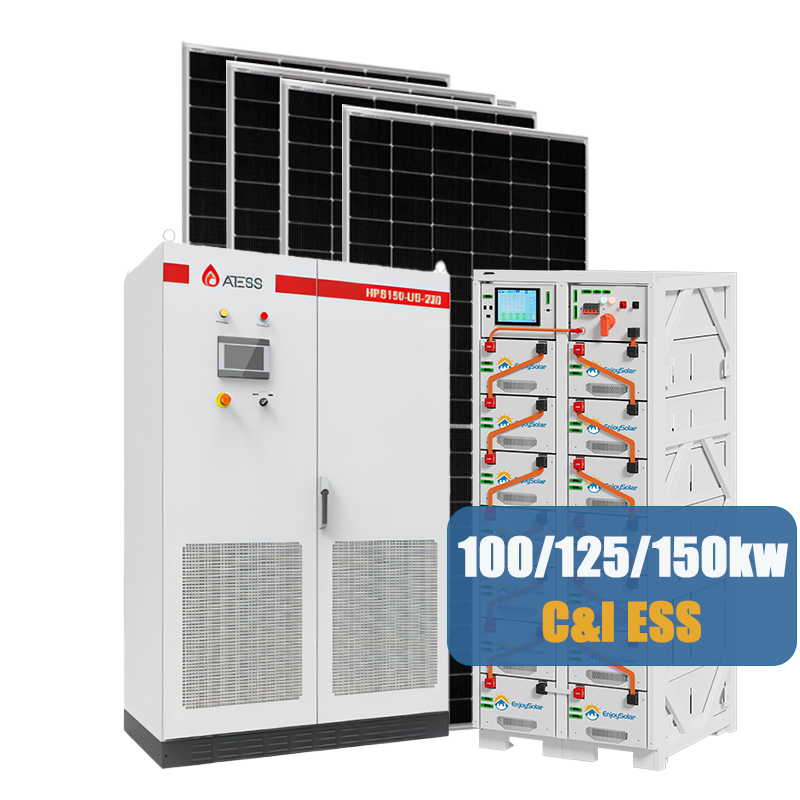
Enjoy Solar ESS provides 100kW, 125kW and 150kW C&I energy storage configurations using LiFePO4 battery technology for commercial and industrial applications.
The 100kW C&I Energy Storage System can be considered for moderate commercial loads and solar self-consumption applications.
For projects with more variable load profiles, the 125kW configuration provides additional power headroom for load management.
Where peak demand and higher-power industrial loads are the primary concerns, the 150kW configuration offers greater instantaneous discharge capability.
For EPC contractors, system integrators and project developers, Enjoy Solar ESS can support configuration evaluation according to actual project requirements.
Request a C&I ESS configuration based on your load profile and solar capacity.
FAQ
Is a 150kW ESS always better than a 100kW ESS?
No. The appropriate power rating depends on the site’s load profile, peak demand, PV capacity and operating strategy. A larger system can increase capital cost without delivering additional value if the site does not require the extra power.
What is the difference between ESS power and battery capacity?
ESS power is measured in kW and determines how much power the system can deliver or absorb at a given moment. Battery capacity is measured in kWh and determines how much energy can be stored and how long the system can operate.
How do I determine the right ESS size for my business?
Start with historical load data, peak demand, PV generation, electricity tariffs and operating schedules. These parameters can then be used to determine the appropriate power and energy capacity.
Is 100kW enough for a commercial building?
It can be, depending on the building’s load profile and storage objectives. If the main goal is solar self-consumption or moderate load shifting, a 100kW system may be sufficient.
When is a 150kW C&I ESS more appropriate?
A 150kW configuration can be considered when a facility has higher instantaneous loads or requires greater power for peak shaving and industrial energy management.