Why Choose 480V Solar Energy Storage System?
Release time: 2026-08-21
Table of Contents
For commercial and industrial facilities, energy storage is no longer simply about keeping electricity in a battery. Factories, warehouses and commercial buildings often have highly variable load profiles, while large electrical equipment can create short but significant demand peaks. The right storage system needs to work with the site’s electrical architecture, load behavior, solar generation and grid strategy.
This is where 480V architecture becomes particularly relevant. It is not merely a voltage specification. It forms part of the electrical foundation connecting the battery system, PCS, solar generation and C&I loads.
Why Does 480V Fit C&I Energy Storage?
Residential energy storage usually deals with relatively simple loads. Commercial and industrial facilities are different. Production lines, HVAC systems, pumps, compressors, refrigeration and motor-driven equipment can operate simultaneously and create substantial instantaneous power demand.
When evaluating a 480V Solar Energy Storage System, therefore, the important question is not simply whether the system operates at 480V. The real issue is how well its electrical architecture fits the site.
A practical C&I project should consider:
- Three-phase distribution voltage
- Rated power of major loads
- PV inverter and PCS compatibility
- Battery power and usable energy capacity
- Transformer and grid interconnection limits
- EMS charging and discharging strategy
Voltage alone does not determine the financial performance of an ESS, but it directly affects equipment integration and compatibility with the site’s electrical infrastructure.
How Can a 480V System Handle Commercial and Industrial Load Peaks?
For many businesses, the critical issue is not how many kilowatt-hours they consume over a month. It is how many kilowatts they draw from the grid during a short interval.
Consider a manufacturing plant starting several high-power machines at the same time. Even if that demand spike lasts only briefly, it can affect the electricity bill when the local tariff includes demand charges.
This is a classic application for a C&I BESS.
With an appropriate EMS strategy, the system can:
- Charge when solar generation is available or site demand is relatively low.
- Monitor the facility’s real-time load.
- Discharge when grid demand approaches a defined threshold.
- Reduce short-duration peak power drawn from the grid.
- Return to normal operating conditions after the peak period.
This operating strategy is commonly known as peak shaving.
The objective is not to eliminate the facility’s electricity consumption. Instead, the battery responds to selected high-demand periods where reducing grid power can create measurable operational or financial value.
That is why a commercial storage project should be evaluated through more than battery capacity. PCS power, EMS controls and the site’s load profile are equally important.
How Should Businesses Choose Between 100kW, 125kW and 150kW?
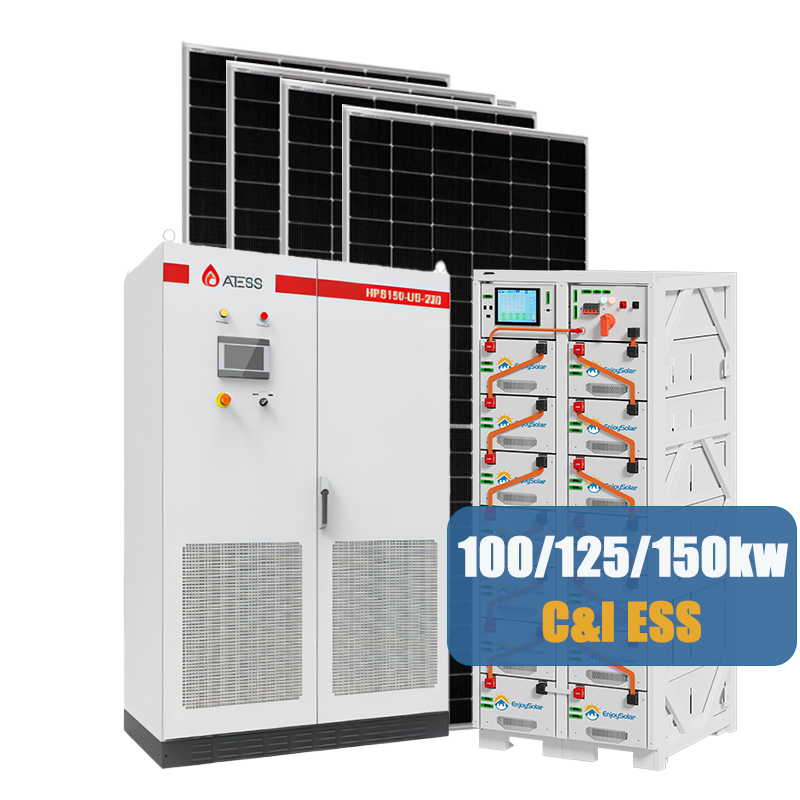
Enjoy Solar ESS offers 100kW, 125kW and 150kW configurations for this C&I energy storage system.
However, the highest rated power is not automatically the best choice.
Two parameters should always be separated:
- kW: how much power the system can deliver or absorb at a given moment
- kWh: how much energy the battery can store
A factory, for example, may require 150kW of instantaneous discharge power to manage a short demand peak without needing enough energy to sustain that output for several hours.
System sizing should therefore start with actual load data.
| Project Factor | Impact on System Selection |
|---|---|
| Peak Demand | Determines required power rating |
| Peak Duration | Influences required battery capacity |
| PV Capacity | Defines available solar generation |
| Daily Load Profile | Determines charging and discharging periods |
| Electricity Tariff | Influences peak shaving and load shifting value |
| Future Load Growth | Affects required expansion headroom |
The meaningful question is not which configuration is the largest. It is which configuration best matches the site’s actual electrical behavior.
Why Is LiFePO4 Suitable for C&I Energy Storage?
Battery chemistry is a major consideration for stationary storage systems expected to cycle regularly.
LiFePO4, or LFP, is widely used in stationary energy storage. For C&I projects, long-term operating stability, thermal characteristics and battery management can be more important than simply maximizing energy density.
A 480V LiFePO4 Energy Storage System can be evaluated across several system-level factors:
- Battery cycling performance
- Thermal stability
- Battery Management System
- State-of-charge management
- PCS power control
- Temperature monitoring
- EMS operating strategy
LiFePO4 alone, however, does not determine the performance of an energy storage project. The interaction between the battery, BMS, PCS, EMS and thermal management system is what ultimately shapes real-world operation.
Which C&I Projects Can Benefit From 480V Storage?
A 480V ESS is not limited to one particular type of business. It can be relevant to commercial and industrial sites with compatible three-phase distribution and substantial electrical loads.
Manufacturing Facilities
Production equipment can create pronounced demand peaks, making battery-based peak shaving useful for load management.
Warehouses
Lighting, HVAC, refrigeration and logistics equipment can create distinct daily load profiles.
Commercial Buildings
Predictable weekday demand can create opportunities for load shifting and better coordination between solar generation and onsite consumption.
Industrial Facilities
High-power equipment places greater demands on system power ratings and PCS response.
Ultimately, the suitability of a 480V system needs to be evaluated against the site’s distribution voltage, load profile, PV capacity and grid interconnection conditions.
How Does Enjoy Solar ESS Support C&I Storage Projects?
For commercial and industrial projects requiring 100kW, 125kW or 150kW-class storage power, Enjoy Solar ESS offers a 480V C&I energy storage system using LiFePO4 battery technology.
The 480V C&I Energy Storage System can support applications including solar energy utilization, peak demand management and commercial or industrial energy management.
For EPC contractors, project developers, system integrators and commercial energy users, selecting an ESS should involve more than comparing battery capacity. Site loads, electrical architecture, peak power, PV capacity and EMS strategy all deserve consideration.
Looking for a 480V storage solution for a commercial or industrial project? Contact Enjoy Solar ESS to evaluate the appropriate 100kW, 125kW or 150kW configuration for the project’s actual requirements.
FAQ
What is a 480V Solar Energy Storage System?
A 480V Solar Energy Storage System combines battery storage with solar generation and is designed for commercial and industrial projects where the site’s electrical infrastructure is compatible with a 480V three-phase architecture.
Why is 480V considered for C&I applications?
C&I facilities commonly use three-phase distribution and operate substantial electrical loads. A 480V ESS must be evaluated together with the site’s distribution equipment, electrical loads, PCS and grid connection.
What is the difference between kW and kWh?
kW represents the power an ESS can deliver or absorb at a specific moment, while kWh represents the amount of energy stored in the battery. Power affects instantaneous response, while energy affects operating duration.
Can a 480V ESS support peak shaving?
Yes. When properly sized and controlled, an ESS can discharge during high-demand periods to reduce the facility’s peak power drawn from the grid.
Why is LiFePO4 used in C&I energy storage?
LiFePO4 offers good thermal stability and established use in stationary energy storage, making it suitable for systems designed for regular cycling. Overall performance also depends on the BMS, PCS, EMS and thermal management architecture.