Why Is a 480V Solar Energy Storage System Ideal for C&I Applications?
Release time: 2026-07-24
Table of Contents
For commercial and industrial facilities, energy storage is no longer simply a way to keep electricity in a battery. The real value comes from how effectively the system works with site loads, three-phase distribution, solar generation and electricity tariffs. For factories, warehouses and commercial buildings with substantial electrical demand, a 480V architecture can provide an effective electrical foundation for integrating solar power and battery storage.
As the C&I storage market matures, buyers are paying closer attention to peak shaving, solar self-consumption, load shifting and backup power rather than battery capacity alone. Energy storage is increasingly becoming an active energy-management asset rather than a passive backup device.
Why Does 480V Matter in C&I Energy Storage?
Commercial and industrial facilities typically have more complex load profiles than residential properties. Production equipment, HVAC systems, pumps, compressors, refrigeration and other industrial loads can operate simultaneously and create significant short-term power peaks.
For these applications, a 480V Solar Energy Storage System can be particularly relevant because the voltage architecture needs to work with the site’s three-phase electrical infrastructure.
A practical system design needs to consider several factors:
- The site’s nominal distribution voltage
- The power requirements of major loads
- Compatibility between PV inverters and the storage PCS
- Battery power and usable energy capacity
- Grid interconnection limits
- EMS-based charging and discharging strategies
In other words, 480V should not be treated as an isolated product specification. It is one part of the complete electrical architecture.
For C&I projects using 100kW, 125kW or 150kW-class storage configurations, coordination between voltage, PCS capacity, site loads and the grid interface becomes especially important.
How Can 480V Energy Storage Help Manage Commercial Loads?
A common misconception is that an energy storage project is mainly about reducing total electricity consumption. In many C&I applications, the more important issue is the amount of power drawn from the grid during a short interval.
That distinction is central to commercial battery storage.
If several high-power machines start at the same time, a manufacturing facility can experience a sharp demand spike. Where utility tariffs include demand charges, that short-lived peak can influence the monthly electricity bill.
A battery system can support peak shaving energy storage strategies by:
- Charging when site demand is lower or solar production is available.
- Monitoring the facility’s real-time load.
- Discharging when grid demand approaches a predefined threshold.
- Limiting short-duration demand peaks.
- Returning to a suitable charging state after the peak period.
The objective is not to eliminate the facility’s electricity consumption. Instead, the battery targets the most expensive or operationally significant periods of grid demand.
That is why modern C&I BESS projects increasingly focus on EMS controls and operating strategies rather than comparing battery capacity alone.
How Should Businesses Choose Between 100kW, 125kW and 150kW?
The rated power of an energy storage system should always be considered against the site’s actual load profile.
| Configuration | Typical Design Question | Main Consideration |
|---|---|---|
| 100kW | Moderate C&I demand | Peak shaving and basic solar utilization |
| 125kW | More variable loads | Peak management and load shifting |
| 150kW | Higher-power industrial loads | Higher demand management and expansion headroom |
One of the most important distinctions in ESS design is the difference between kW and kWh.
kW describes how much power the system can deliver or absorb at a given moment. kWh describes how much energy the battery stores and therefore how long it can sustain a particular output.
A facility may need substantial instantaneous power to control a demand peak without requiring a large amount of energy for several consecutive hours. That is why choosing the largest available configuration is not automatically the best engineering decision.
Load data, tariff structures, PV output, operating schedules and the intended storage strategy should all be considered. Current C&I storage guidance increasingly emphasizes data-driven sizing rather than selecting battery capacity in isolation.
Why Does LiFePO4 Fit C&I Energy Storage?
Battery chemistry is another important part of C&I storage design.
LiFePO4, or LFP, has become a widely used chemistry for stationary energy storage. Commercial and industrial projects often require repeated charging and discharging, making predictable operation and long-term system management important design considerations.
A 480V LiFePO4 Energy Storage System can be designed around several practical objectives:
- Stable cycling performance
- Good thermal stability
- Integration with battery management and protection systems
- Regular charge and discharge scheduling
- Coordination with photovoltaic generation
LiFePO4 alone, however, does not determine whether a project will deliver a strong financial return. Battery degradation, thermal management, PCS efficiency, EMS controls and actual operating conditions all influence the complete system’s performance.
Which C&I Applications Can Benefit From 480V Solar Storage?
Energy storage is rarely deployed as a standalone asset in commercial and industrial facilities.
Manufacturing facilities
Production equipment can create sharp demand peaks, making storage-based peak management particularly relevant.
Warehouses and logistics facilities
Lighting, HVAC, refrigeration and material-handling equipment can produce distinct daily load profiles. Solar and storage can work together to increase onsite energy utilization.
Commercial buildings
Office and commercial facilities often have predictable weekday demand patterns, creating opportunities for load shifting, solar self-consumption and backup power.
Industrial parks
Multiple loads can be aggregated into a broader energy-management strategy where battery storage becomes part of the site’s electrical infrastructure.
Ultimately, the suitability of a 480V system depends on the actual load profile, electrical architecture and operating objectives of the project.
How Can Enjoy Solar ESS Support C&I Storage Projects?
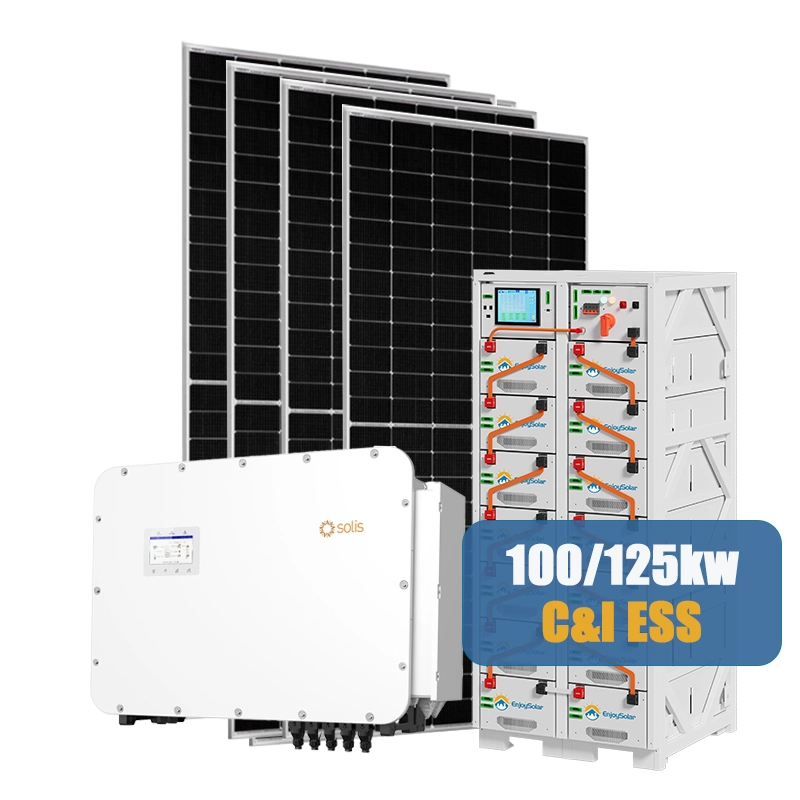
For commercial and industrial projects requiring 100kW, 125kW or 150kW-class storage power, Enjoy Solar ESS offers a 480V solar energy storage system built around LiFePO4 battery technology.
480V Solar Energy Storage System
For project developers, EPC contractors, system integrators and commercial energy users, selecting an ESS should involve more than comparing battery capacity. Load profiles, peak power, PV generation, grid conditions and the intended operating strategy all deserve consideration.
Need help evaluating a 100kW, 125kW or 150kW configuration for a C&I project? Contact Enjoy Solar ESS for a storage solution aligned with the project’s electrical and operational requirements.
FAQ
What is a 480V Solar Energy Storage System?
A 480V Solar Energy Storage System combines solar generation with battery storage and is designed for projects where the site’s electrical architecture and loads are compatible with a 480V system.
Why is 480V suitable for C&I energy storage?
480V is commonly associated with three-phase commercial and industrial electrical systems. Whether it is appropriate for a specific project depends on the site’s distribution infrastructure, load requirements and grid connection.
What is the difference between kW and kWh?
kW represents the power that an energy storage system can deliver or absorb at a given moment. kWh represents the amount of energy stored in the battery and influences the system’s operating duration.
Can a 480V ESS be used for peak shaving?
Yes. When properly sized and controlled, a battery energy storage system can discharge during high-demand periods to reduce the facility’s instantaneous grid demand.
Why is LiFePO4 commonly used in C&I storage?
LiFePO4 provides characteristics well suited to stationary storage, including good thermal stability and established cycling behavior. Overall performance also depends on the BMS, thermal management, PCS and operating strategy.